
Short answer
A limited company buy-to-let is usually worth it for higher-rate taxpayers with mortgages who buy new property and leave the profit in the company to grow the portfolio. It is usually not worth it for basic-rate landlords, landlords with little borrowing, or anyone who needs to live on the rent, because profit taken out is taxed twice. Moving property you already own into a company is a separate and costlier decision.
Figures checked against GOV.UK and HMRC guidance.
What does limited company buy-to-let mean?
You set up a company, often called a special purpose vehicle (SPV), whose only business is owning and letting property. The company buys the property, takes out the mortgage and receives the rent. You own the shares and are usually a director.
The company is a separate taxpayer. Its profit belongs to the company, not to you, until it pays you a dividend, a salary or repays money you lent it.
The company claims the same running costs as an individual landlord, from repairs to agent fees, as set out in our guide to landlord allowable expenses.
How is a limited company buy-to-let taxed?
There are two layers of tax, and the case for a company depends on how they add up for you.
- Mortgage interest is deducted in full. The rule that limits individual landlords to a 20% tax reduction does not apply. HMRC's manual says companies "are not affected". HMRC manual PIM2054
- Profit pays Corporation Tax. The rate is 19% on profits up to £50,000 and 25% on profits over £250,000, with marginal relief between. The limits are shared between associated companies. GOV.UK
- Money you take out is taxed again. Dividends above the £500 allowance are taxed at 10.75% (basic rate), 35.75% (higher rate) and 39.35% (additional rate) in 2026/27. GOV.UK
- Gains on sale pay Corporation Tax too. Companies get no annual exempt amount. HMRC manual CG10247
Compare that with owning personally, where the whole profit before interest is taxed at your income tax rate and interest earns only the basic-rate reduction. Our guide to claiming mortgage interest shows how that restriction works.
Is a limited company buy-to-let worth it? Two examples
Illustrative example
A higher-rate landlord with a mortgage
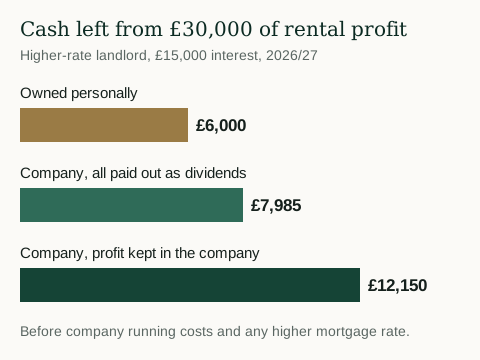
Assumptions: salary already above the higher rate threshold, rental profit of £30,000 before £15,000 of mortgage interest, same interest rate either way, profit under £50,000 in the company, no other dividends, no associated companies.
| Personally: 40% of £30,000, less 20% of £15,000 | £9,000 tax |
| Cash left, owned personally | £6,000 |
|---|---|
| Company: Corporation Tax at 19% on £15,000 | £2,850 tax |
| Cash left in the company | £12,150 |
| Dividend tax at 35.75% on £12,150, after the £500 allowance | £4,165 tax |
| Cash left if all is paid out | £7,985 |
The company is ahead by £1,985 a year even when every pound is paid out, and by £6,150 while profit stays in the company.
Company running costs and a higher company mortgage rate come out of that gap. If the company's interest were £1,500 higher, the paid-out figure would fall by about £780.
Illustrative example
A basic-rate landlord with no mortgage
Assumptions: salary of £25,000, rental profit of £15,000 with no borrowing, so all income stays within the basic rate band either way.
| Personally: 20% of £15,000 | £3,000 tax |
| Cash left, owned personally | £12,000 |
|---|---|
| Company: Corporation Tax at 19%, then dividend tax at 10.75% on £12,150 after the allowance | £4,102 tax |
| Cash left if all is paid out | £10,898 |
Owning personally leaves £1,102 more. Even with all profit kept in the company the gain is only £150, which company running costs would more than use up.
Does the April 2027 change make a company worth it?
From 6 April 2027, property income of individuals in England, Wales and Northern Ireland is due to be taxed at 22% (property basic rate), 42% (property higher rate) and 47% (property additional rate). The interest reduction rises to 22%. HM Treasury technical note
In Example A, personal tax rises by £300 a year to £9,300. In Example B it rises by £300 to £3,300. The change widens the gap for higher-rate landlords, but it does not turn a poor case for a company into a good one.
Dividend rates already rose from 6 April 2026, which narrowed the company's advantage for landlords who take the profit out. HM Treasury technical note
What does a company cost beyond tax?
- Mortgages. Fewer lenders offer company buy-to-let loans, rates and fees are usually higher, and directors are normally asked for personal guarantees.
- Accounts and filings. The company files statutory accounts at Companies House, a Corporation Tax return and a confirmation statement every year. Our limited company property accountants handle these.
- Stamp Duty Land Tax. Companies pay the 5% surcharge on residential purchases, and a flat 17% on homes costing more than £500,000, unless a relief applies. GOV.UK An individual who already owns a home pays the same surcharge, so for many landlords the purchase cost is similar.
- ATED. A company owning a home worth more than £500,000 falls into the Annual Tax on Enveloped Dwellings. GOV.UK Commercial lets to unconnected tenants can get relief, but a return is still needed to claim it. GOV.UK
- Less flexibility. Profit is not yours to spend until it is paid out, and lending money in or taking it out needs proper records through a director's loan account.
Can you move property you already own into a company?
You can, but it is treated as selling the property to the company at market value. You may owe Capital Gains Tax on the growth in value, and the company pays Stamp Duty Land Tax on the full value.
Incorporation relief can defer the gain only where the letting amounts to a business, which depends on the work involved. For transfers from 6 April 2026 it must be claimed on your tax return. GOV.UK policy paper
Refinancing and early repayment charges add to the bill. That is why many landlords keep existing property personally and buy only new property in a company. Our portfolio planning and incorporation service models both routes.
Who is a limited company buy-to-let worth it for?
A company is more likely to be worth it if most of these apply to you:
- you pay higher or additional rate tax on your other income
- the property carries a large mortgage
- you do not need the rent to live on and plan to reinvest it
- you are buying new property rather than moving existing property
- you expect to hold for many years
It is usually not worth it if you are a basic-rate taxpayer, borrow little, need the income now, plan a short hold or own only one property with low profit.
Before choosing a company, check the simpler options. A married couple who own a property in unequal shares may cut tax with Form 17. To see your personal tax, use the rental income tax calculator.
Our honest view: a company is a tool for growing a geared portfolio, not a general tax saving. Most of its advantage comes from deferring tax on profit you leave in the company.
What mistakes do landlords make with company buy-to-let?
- Comparing Corporation Tax with income tax alone. The second layer, tax on money you take out, is where the saving often goes.
- Ignoring the mortgage rate. A higher company rate can cancel the tax gain on a small property.
- Putting the deposit in as share capital. Lending it to the company instead means you can take it back later without tax.
- Moving existing property on the strength of a sales pitch. Schemes that promise to remove Capital Gains Tax and Stamp Duty Land Tax often rely on positions HMRC disputes.
- Spending company money as your own. An overdrawn director's loan account brings its own tax charges.
The bottom line
A limited company buy-to-let is worth it for some landlords and a costly mistake for others. The deciding numbers are your tax band, your borrowing and whether you need the profit now.
Higher-rate landlords with mortgages who reinvest usually come out ahead. Basic-rate landlords, cash buyers and anyone who lives on the rent usually do not.
Run your own figures both ways before you buy. For the wider picture, start with the Landlord Tax Guide or how to reduce tax on rental income legally.
Related questions
Can a limited company claim mortgage interest on a buy-to-let?
Yes. A company deducts interest and other finance costs in full from its rental profit. The restriction to a basic-rate tax reduction applies only to individuals, partnerships and trusts. HMRC manual PIM2054
Does a company pay more Stamp Duty on a buy-to-let?
A company pays the 5% surcharge on residential purchases. GOV.UK An individual who already owns a home pays the same surcharge on a buy-to-let, so the difference is often small. Transferring property you already own into a company is different, because the company pays on its full market value.
Is it worth putting one buy-to-let in a limited company?
Sometimes, if it is heavily mortgaged and you are a higher-rate taxpayer who does not need the income. With one modestly geared property, company running costs and a higher mortgage rate often cancel the tax saving.
Does Making Tax Digital apply to a property company?
No. Making Tax Digital for Income Tax applies to individuals with property or self-employed income. A company files Corporation Tax returns instead.
Official sources
- PIM2054: Restriction of finance costs for income tax (ITTOIA 2005, sections 272A and 272B) HMRC
- Corporation Tax rates and reliefs GOV.UK
- Tax on dividends GOV.UK
- CG10247: Capital Gains Tax basic concepts, companies only HMRC Capital Gains Manual
- Change to tax rates for property, savings and dividend income: technical note (26 November 2025) HM Treasury / HMRC
- Stamp Duty Land Tax: corporate bodies GOV.UK
- Annual Tax on Enveloped Dwellings: the basics GOV.UK
- Annual Tax on Enveloped Dwellings: reliefs and exemptions GOV.UK
- Capital Gains Tax: Incorporation Relief claims process (policy paper, 26 November 2025) GOV.UK
Figures were checked against these sources on . Tax rules change: check the source or ask us before acting.
Please note: this guide is general information on UK tax rules at the review date shown. It is not advice for your situation. Rules change and the right answer depends on your circumstances, so check the sources or speak to us before acting.