
Short answer
Individual landlords cannot deduct mortgage interest from residential rent. Instead they get a tax reduction of 20% of their finance costs, so basic-rate taxpayers are largely unaffected and higher-rate taxpayers lose relief. Limited companies can still deduct interest in full, and from 2027/28 the reduction rises to 22%.
Figures checked against GOV.UK and HMRC guidance.
What mortgage interest can landlords claim?
The rules cover all finance costs, not just mortgage interest. That includes interest on other loans used to buy or improve the let property, and the costs of arranging that finance, such as arrangement and broker fees. HMRC guidance
Capital repayments are never deductible, whatever the type of mortgage.
How does the mortgage interest tax reduction work?
Your finance costs are left out when working out rental profit. HMRC then reduces your tax bill by 20% of the lowest of:
- your finance costs for the year, plus any unused amount brought forward
- your property business profit for the year, after losses brought forward
- your adjusted total income above the personal allowance (excluding savings and dividend income)
If item 2 or 3 is the lowest, the unused finance costs carry forward to later years.
Who does this apply to?
Individuals, partnerships of individuals and trusts letting residential property, including HMOs. It does not apply to limited companies or to commercial property. The legislation is section 272A of the Income Tax (Trading and Other Income) Act 2005.
The restriction was phased in from 6 April 2017 and has applied in full since 6 April 2020.
Illustrative example
A higher-rate landlord in 2026/27
Assumptions: England, salary £45,000, one property owned personally, rent £20,000, other allowable costs £3,000, mortgage interest £9,000, no other income.
| Rental profit before interest (£20,000 − £3,000) | £17,000 |
| Total income (£45,000 + £17,000) | £62,000 |
| Extra income tax caused by the rental profit | £5,746 |
| Less tax reduction: 20% × £9,000 | (£1,800) |
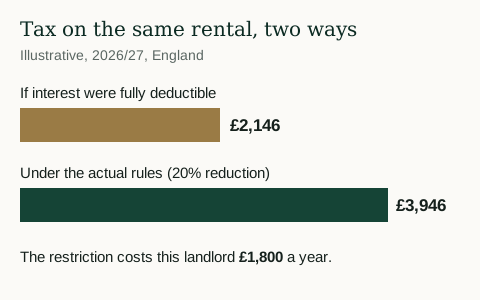
| Tax on the rental | £3,946 |
|---|---|
| Tax if interest were fully deductible | £2,146 |
| Extra tax caused by the restriction | £1,800 |
The landlord's cash profit after interest is £8,000, but the tax is £3,946. The rental profit takes total income to £62,000, so £11,730 of it is taxed at 40%.
Check your own figures with the rental income tax calculator.
What mistakes do landlords make with mortgage interest?
- Entering interest as an expense. On the return, residential finance costs go in their own box, not with other expenses.
- Leaving out arrangement and broker fees. They are finance costs and qualify for the reduction.
- Claiming the whole mortgage payment. Only the interest part counts.
- Forgetting unused amounts. Finance costs restricted in one year carry forward, so track them.
What should landlords consider?
- Your band can change without your income changing. Taxable rental profit can be much higher than cash profit. That can push you into the higher rate, or above £100,000, where the personal allowance starts to be withdrawn.
- Ownership splits matter. Married couples are taxed 50:50 by default unless they own unequal shares and file Form 17.
- Companies are treated differently, but moving property into one is costly. See incorporating a property portfolio, or our SPV accountant service if you already own through one.
- The 2027 rate rise works both ways. Rental profit will be taxed two points higher, but the interest credit also rises to 22%, so the net effect depends on how much interest you pay. HM Treasury technical note
Scottish taxpayers pay Scottish income tax rates on rental profit, so the figures above differ for them. Savings and dividend income, pension contributions, Gift Aid and losses can also change the answer.
The bottom line
Landlords who own property personally can still get relief for mortgage interest, but only as a 20% tax reduction.
If all your income stays in the basic rate, you lose little. If rental profit takes you into the higher rate, the restriction can cost you a large part of your cash profit.
Before changing how you own property, work out what the restriction costs you now and under the 2027 rates.
The finance cost reduction goes on your return each year, so diarise the deadlines with our landlord tax checklist.
Related questions
Can I claim the capital part of my repayment mortgage?
No. Only interest and finance costs count, and only through the tax reduction. Capital repayments are never deductible.
What happens to finance costs I could not use this year?
They carry forward. If your property profit or your income above the personal allowance limits the reduction, the unused finance costs are added to next year's figure. HMRC guidance
Does the restriction apply to furnished holiday lets?
Yes, now. Holiday lets used to be outside it, but the special holiday-let rules have been abolished, so interest on a former holiday let gets the same 20% credit as any other let. GOV.UK
Does it apply to commercial property?
No. The restriction applies to residential lettings. Interest on commercial property can still be deducted.
Official sources
- Restricting finance cost relief for individual landlords: how it's worked out, including case studies HMRC
- Income Tax (Trading and Other Income) Act 2005, section 272A legislation.gov.uk
- Change to tax rates for property, savings and dividend income: technical note (26 November 2025) HM Treasury / HMRC
- Income Tax rates and Personal Allowances GOV.UK
- Furnished holiday lettings tax regime abolition GOV.UK
Figures were checked against these sources on . Tax rules change: check the source or ask us before acting.
Please note: this guide is general information on UK tax rules at the review date shown. It is not advice for your situation. Rules change and the right answer depends on your circumstances, so check the sources or speak to us before acting.