
Short answer
Rental profit is rent less allowable expenses. It is added to your other income and taxed at your income tax rates: for 2026/27 in England and Wales, 20% up to £50,270, 40% above that and 45% above £125,140. Mortgage interest earns a 20% tax reduction, and no National Insurance is normally due.
Figures checked against GOV.UK and HMRC guidance.
How is rental income taxed, step by step?
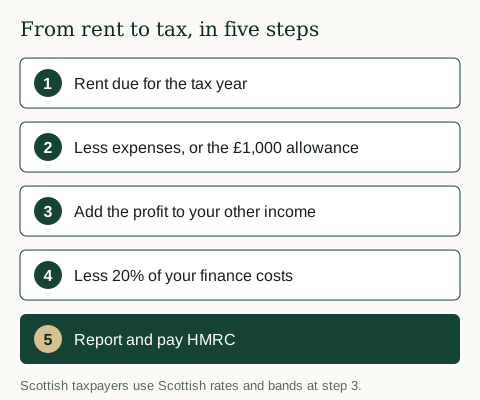
Step 1: Work out the rent for the year
Include all rent due for the tax year (6 April to 5 April). Add payments for services you provide, such as cleaning or bills in a bills-inclusive rent.
Tenancy deposits are not income unless you keep some of them, for example to cover damage or unpaid rent.
Step 2: Deduct allowable expenses, or the property allowance
Deduct the revenue costs of the letting (see landlord allowable expenses), or the £1,000 property allowance if that is higher. You cannot use both. GOV.UK
Step 3: Add the profit to your other income
The profit is taxed at your marginal rate. For 2026/27 the personal allowance is £12,570. The basic rate of 20% applies up to £50,270, the higher rate of 40% above that, and the additional rate of 45% above £125,140. GOV.UK
Above £100,000 of income the personal allowance is reduced by £1 for every £2.
Step 4: Take off the finance cost reduction
Mortgage interest gives a 20% reduction in your tax bill. See how the mortgage interest restriction works.
Step 5: Report and pay
Report on your Self Assessment return by 31 January, or through Making Tax Digital if your qualifying income is over £50,000. Qualifying income is your gross rent plus any self-employed turnover, before expenses. GOV.UK
Pay the balance by 31 January after the tax year ends. Larger bills also bring payments on account, explained in the questions below.
Illustrative example
A basic-rate landlord in 2026/27
Assumptions: England, salary £25,000, one flat owned personally, rent £9,600, allowable costs £2,100, mortgage interest £3,000.
| Rent | £9,600 |
| Less allowable costs | (£2,100) |
| Rental profit (interest not deducted) | £7,500 |
|---|---|
| Income tax on the profit at 20% | £1,500 |
| Less tax reduction: 20% × £3,000 interest | (£600) |
| Tax due on the rental | £900 |
Salary of £25,000 plus profit of £7,500 is £32,500, well within the basic rate band, so the whole profit is taxed at 20%.
Try your own figures in the rental income tax calculator.
What mistakes do landlords make when reporting rental income to HMRC?
- Claiming the property allowance and expenses together. It is one or the other.
- Reporting the whole rent on a jointly owned property. Each owner is taxed on their own share.
- Missing payments on account. A first return with rental profit can bring a bill for that year plus a first payment towards the next.
- Leaving out rent that was due but not yet paid. Rent is generally taxed for the year it is due.
When is rental income taxed differently?
- Scotland: Scottish taxpayers pay Scottish income tax rates and bands on rental profit.
- From 2027/28: rental profit gets its own set of rates, 22% (property basic rate), 42% (property higher rate) and 47% (property additional rate), two points above the rates on earned income. HM Treasury
- Company ownership: a company pays Corporation Tax instead. See our accountants for buy-to-let limited companies.
- Living in the property: letting a furnished room in your own home may fall under rent-a-room relief instead. GOV.UK
The bottom line
Rental income is taxed as part of your total income, so the same rental profit can cost one landlord 20% and another 40% or more.
Work out the profit, add it to your other income, take off 20% of your finance costs, and you have the tax.
The figures change from April 2027, so recheck any estimate made on 2026/27 rates.
For every filing and payment date in one place, use the landlord tax checklist.
Related questions
Do I pay National Insurance on rental income?
Not normally. Rental income from letting property is investment income, not trading income. The position can differ only in unusual cases where letting amounts to a business with significant services.
Do I need to report rental income to HMRC?
Yes, if it is over £1,000 a year. Between £1,000 and £2,500 you contact HMRC. Above £2,500 after expenses, or £10,000 before expenses, you file a Self Assessment return. GOV.UK
When do I pay tax on rental income?
The balance for a tax year is due by 31 January after it ends.
If last year's bill was £1,000 or more and less than 80% was collected at source, you also make payments on account by 31 January and 31 July, each half of last year's bill. GOV.UK
Is rental income taxed differently in Scotland?
Yes. Scottish taxpayers pay Scottish income tax rates and bands on rental profit. GOV.UK
Official sources
- Renting out a property: paying tax GOV.UK
- Income Tax rates and Personal Allowances GOV.UK
- Tax-free allowances on property and trading income GOV.UK
- Restricting finance cost relief for individual landlords: how it's worked out, including case studies HMRC
- Work out your qualifying income for Making Tax Digital for Income Tax GOV.UK
- Understand your Self Assessment tax bill: payments on account GOV.UK
- Change to tax rates for property, savings and dividend income: technical note (26 November 2025) HM Treasury / HMRC
- Rent a room in your home GOV.UK
Figures were checked against these sources on . Tax rules change: check the source or ask us before acting.
Please note: this guide is general information on UK tax rules at the review date shown. It is not advice for your situation. Rules change and the right answer depends on your circumstances, so check the sources or speak to us before acting.