
Short answer
Form 17 lets spouses and civil partners who live together be taxed on their actual, unequal shares of a jointly owned property. It only works if the unequal ownership is real, both of you sign it, and HMRC receives it within 60 days. It applies from the date of the second signature.
Figures checked against GOV.UK and HMRC guidance.
What is Form 17 and why does it matter?
When a married couple or civil partners live together and own a rental jointly, the tax rules treat the profit as split 50:50. That happens even if one of you owns most of the property. Income Tax Act 2007, s836
Form 17 is the way out of that default. It is a joint declaration telling HMRC that your beneficial interests are unequal, so each of you is taxed on what you actually own. Income Tax Act 2007, s837
The saving comes when one partner pays a higher rate of tax and the other has a lower income or unused personal allowance. If you both pay the same rate, an unequal split may make little difference.
Who can use Form 17?
Only spouses and civil partners who live together. The 50:50 rule does not apply to anyone else, so there is nothing for them to opt out of. HMRC manual
- Unmarried couples, siblings and friends who own together are already taxed on their actual entitlement. They do not use Form 17.
- Separated couples are outside the 50:50 rule too, so they cannot make a declaration.
- Trading partnership income is not covered by the 50:50 rule. HMRC manual
Do you need to change ownership before filing Form 17?
Often, yes. Form 17 records ownership; it cannot create it. The split you declare must match who is genuinely entitled to the property and its income. HMRC manual
Joint names are presumed to be a joint tenancy, where neither of you owns a share as such. A Form 17 cannot be made for a beneficial joint tenancy, so equal joint tenants must first change how they hold the property. HMRC manual
A declaration of trust setting out unequal shares is the usual route. A Land Registry restriction or a notice severing the joint tenancy can also be evidence.
What changing ownership can cost
- Capital Gains Tax. Giving a share to a spouse or civil partner you live with does not normally create a taxable gain. GOV.UK
- Stamp Duty Land Tax. If the partner receiving a share also takes on part of the mortgage, that share of the debt can count as payment for SDLT. HMRC SDLT manual In Wales, Land Transaction Tax applies instead.
- The money itself. A bigger share means a bigger slice of the rent and of the sale proceeds. Check your lender’s consent too.
How do you make a Form 17 declaration?
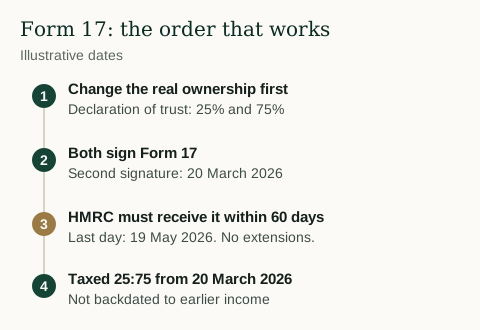
- Gather evidence. HMRC expects proof of the unequal shares, such as the declaration of trust, sent with the form. HMRC manual
- Complete the form. Fill it in on GOV.UK, then print it. It cannot be saved part-way, so have the details ready. GOV.UK
- List every property. A declaration covers only the assets named on it. A property you buy later needs its own declaration. HMRC manual
- Both sign and date it. It can go to either partner’s tax office. HMRC manual
- Send it quickly. HMRC must receive it within 60 days of the declaration date. There is no power to extend this, and a late form has no effect. HMRC manual
The declaration date is when the second of you signs. The new split applies to income from that date onwards, never to income before it. HMRC manual
Use recorded delivery and keep a copy, so you can show when HMRC received it.
How much tax can Form 17 save?
Illustrative example
A married couple with one jointly owned rental in 2026/27
Tom earns a £60,000 salary. Priya has no other income. Their flat makes £12,000 profit a year, ignoring finance costs. They sign a declaration of trust giving Priya 75% and Tom 25%, then a Form 17. Tom signs second, on 20 March 2026.
- Without Form 17 (50:50). Tom pays 40% on £6,000, which is £2,400. Priya’s £6,000 is covered by her £12,570 personal allowance. Total £2,400.
- With Form 17 (25:75). Tom pays 40% on £3,000, which is £1,200. Priya’s £9,000 is still within her allowance. Total £1,200.
That is £1,200 less tax for 2026/27, because HMRC received the form by 19 May 2026. The saving is real only because Priya now owns 75% of the flat, including 75% of any sale proceeds.
Enter each partner's share in the rental income tax calculator to compare splits on your own figures.
From April 2027 property income is due to be taxed at 22% (property basic rate), 42% (property higher rate) and 47% (property additional rate), so the gap between partners’ rates may matter more. HM Treasury technical note
When does a Form 17 declaration stop?
Once accepted, the split carries on each year. You cannot simply cancel it. It ends when either of you dies, you separate permanently, you divorce or dissolve the partnership, or either share changes at all. HMRC manual
After a change in shares, the 50:50 default returns unless you make a fresh declaration showing the new position. There is no limit on how many declarations you can make, but each must reflect reality.
Common Form 17 mistakes
- Declaring a split you do not have. HMRC can reject a declaration that does not match the evidence.
- Missing the 60 days. A late form is invalid. You have to sign a new one and lose the income before the new date.
- Expecting it to cover past years. It works only from the date of the second signature.
- Forgetting new purchases. A second property is not covered by the first declaration.
- Moving a small share later. Any change ends the declaration, so plan the split once.
The bottom line
Form 17 does not move income between you; it makes the tax follow ownership you have already arranged. For couples whose tax rates differ, that can be worth doing every year the property is let.
Decide the real split first, weigh the mortgage, SDLT and sale-proceeds effects, then get the form to HMRC well inside the 60 days.
Our landlord tax checklist includes a yearly prompt to check your joint ownership split.
Related questions
Can we choose any split we like on Form 17?
No. The split must match your actual beneficial shares in the property and its income. If you want a different split, you must change the real ownership first. HMRC manual
Does Form 17 apply to a property owned through a limited company?
No. A limited company is taxed on its own profits. Form 17 is for income from property that a married couple or civil partners own personally.
Do unmarried couples need Form 17?
No. The 50:50 rule applies only to spouses and civil partners who live together. Other joint owners are taxed on their actual shares without any declaration. HMRC manual
Can we backdate a Form 17?
No. It applies from the date the second partner signs, provided HMRC receives it within 60 days. Income before that date stays split 50:50. HMRC manual
Official sources
- Income Tax Act 2007, section 836 legislation.gov.uk
- Income Tax Act 2007, section 837 legislation.gov.uk
- TSEM9814: The 50/50 rule and exclusions HMRC
- TSEM9844: Form 17 rule, who can make a declaration HMRC
- TSEM9850: Form 17 rule, declaration must reflect reality HMRC
- TSEM9230: Joint ownership, presumption of joint tenancy HMRC
- TSEM9851: Form 17 rule, evidence HMRC
- Declare beneficial interests in joint property and income (Form 17) GOV.UK
- TSEM9854: Form 17 rule, property not covered by a declaration HMRC
- TSEM9852: Form 17 rule, how a couple make a declaration HMRC
- TSEM9862: Form 17 rule, strict time limit HMRC
- TSEM9860: Form 17 rule, when a declaration takes effect HMRC
- TSEM9864: Form 17 rule, when a declaration stops HMRC
- Capital Gains Tax: gifts to your spouse or civil partner GOV.UK
- SDLTM04040: Assumption or release of a debt HMRC
- Change to tax rates for property, savings and dividend income: technical note (26 November 2025) HM Treasury / HMRC
Figures were checked against these sources on . Tax rules change: check the source or ask us before acting.
Please note: this guide is general information on UK tax rules at the review date shown. It is not advice for your situation. Rules change and the right answer depends on your circumstances, so check the sources or speak to us before acting.