
Short answer
You reduce tax on rental income legally by claiming every allowable expense, using the right allowance, getting the mortgage interest credit right, splitting income with a spouse to match real ownership, and using past losses. For larger portfolios, ownership structure matters. Not declaring rent is evasion, not planning.
Figures checked against GOV.UK and HMRC guidance.
Can you avoid paying tax on rental income?
No. Rental profit from UK property is taxable, and leaving it off your return is tax evasion. HMRC can collect the unpaid tax for earlier years, with interest and penalties on top. GOV.UK
What you can do is make sure you pay only what the law requires. Most landlords who overpay do so through missed claims and poor records, not through a lack of clever schemes.
How can landlords reduce tax on rental income?
1. Claim every allowable expense
Agent fees, repairs, insurance, safety certificates, service charges, accountancy and travel for the letting can all be deducted. Like-for-like replacement furniture qualifies too, which matters most for HMO landlords furnishing several rooms.
Our guide to landlord allowable expenses covers the full list and the repair or improvement test.
Costs from up to seven years before your first tenant moved in can count, if they would have been allowable once letting began. HMRC Property Income Manual
2. Get mortgage interest relief right
Mortgage interest is not deducted from rent. It earns a 20% tax reduction instead. Arrangement fees and interest on loans used for the property count as well. Missing them is a common, avoidable overpayment. See can landlords claim mortgage interest?
3. Use the property allowance when your costs are low
If your expenses are small, you can deduct the £1,000 property allowance instead of actual costs. You cannot use both, or use it for rent from a company or partnership that you or someone connected to you controls. GOV.UK
4. Rent a room in your own home
If you let furnished accommodation in the home you live in, the Rent a Room Scheme lets you earn up to £7,500 a year tax-free, or £3,750 if you share the income. It does not cover a separate buy-to-let. GOV.UK
5. Split joint income to match real ownership
Married couples and civil partners who live together are taxed 50:50 on jointly held property by default, whatever their actual shares. HMRC manual
If you genuinely own the property in unequal shares, you can declare this on Form 17 so each of you is taxed on your real share. HMRC must receive it within 60 days of the declaration, with no extension. HMRC manual
Our Form 17 guide covers who can use it, changing ownership first and the steps.
6. Use rental losses
A loss on your lettings carries forward automatically and reduces future profits from the same property business. It cannot be set against your salary or pension. Make sure losses are reported, or they are easy to lose track of. HMRC Property Income Manual
7. Be realistic about pensions
Rental income does not count as relevant UK earnings for pension tax relief. HMRC Pensions Tax Manual
If rent is your only income, relief is limited to contributions of up to £3,600 gross a year in a relief-at-source scheme. If you also have a salary, relief is based on that salary.
8. Review how you own the properties
A company pays Corporation Tax at 19% on profits up to £50,000, and deducts mortgage interest in full. GOV.UK Our limited company property accountants explain how that works in practice.
But moving existing property into a company is treated as a sale, which can trigger Capital Gains Tax and Stamp Duty Land Tax. Model it before deciding: see portfolio tax planning and incorporation.
From April 2027 property income is due to be taxed at 22% (property basic rate), 42% (property higher rate) and 47% (property additional rate), which makes reviewing structure more worthwhile. HM Treasury technical note
How much can splitting joint income save?
Illustrative example
A married couple with one rental property in 2026/27
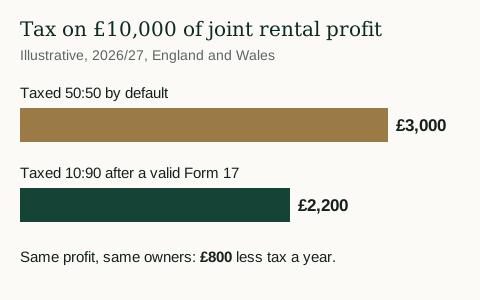
Asha and Ben are married and live together. They own a buy-to-let as tenants in common: Ben 90%, Asha 10%. Asha is a higher-rate taxpayer. Ben earns £20,000. The property makes £10,000 profit, ignoring finance costs.
- Default 50:50. Asha pays 40% on £5,000, which is £2,000. Ben pays 20% on £5,000, which is £1,000. Total £3,000.
- After a valid Form 17 (10:90). Asha pays 40% on £1,000, which is £400. Ben pays 20% on £9,000, which is £1,800. Total £2,200.
The saving is £800 a year, and it works only because Ben really does own 90%. Ben stays within the basic rate band with a total income of £29,000.
Run each owner's share through the rental income tax calculator to test your own split.
What does not reduce tax on rental income?
- Not declaring rent. It is evasion, and the unpaid tax and interest build up every year it goes on.
- A Form 17 that does not reflect reality. The declaration must match who really owns the property. Changing the actual ownership can affect the mortgage and other taxes, so take advice first.
- Claiming improvements as repairs. Capital work only counts when you sell.
- Incorporating on tax alone. Transfer costs, mortgage rates and extracting money from the company can outweigh the saving.
The bottom line
You cannot avoid tax on rental income, but you can usually reduce it legally by claiming everything the rules allow and matching the tax to who really owns the property.
Start with expenses, mortgage interest and joint ownership. Leave ownership structure until you have modelled it on your own figures.
Missed deadlines cost money too, so keep the landlord tax checklist to hand.
Related questions
Is it legal to reduce tax on rental income?
Yes. Claiming allowable expenses, reliefs and allowances, and taxing income on its true owner, is using the law as intended. Hiding income or inventing costs is not.
Can I put all the rental income in my spouse’s name?
Only if they genuinely own all of it. Joint income is taxed 50:50 unless a Form 17 declares the real, unequal shares. HMRC manual
Do I pay less tax through a limited company?
Sometimes, mainly for higher-rate landlords with mortgages who plan to keep profits in the company. It depends on your figures, so model it first.
What if I have not declared rental income in the past?
Tell HMRC before it contacts you. Penalties are generally lower when you come forward yourself than when HMRC finds the income first. Get advice on how to disclose.
Official sources
- Renting out a property: paying tax GOV.UK
- PIM2505: Pre-commencement expenses HMRC Property Income Manual
- Tax-free allowances on property and trading income GOV.UK
- Rent a room in your home: the Rent a Room Scheme GOV.UK
- TSEM9814: The 50/50 rule and exclusions HMRC
- Income Tax Act 2007, section 836 legislation.gov.uk
- TSEM9862: Form 17 rule, strict time limit HMRC
- PIM4210: Losses, individuals HMRC
- PTM044100: Relevant UK earnings HMRC
- Corporation Tax rates and reliefs GOV.UK
- Change to tax rates for property, savings and dividend income: technical note (26 November 2025) HM Treasury / HMRC
Figures were checked against these sources on . Tax rules change: check the source or ask us before acting.
Please note: this guide is general information on UK tax rules at the review date shown. It is not advice for your situation. Rules change and the right answer depends on your circumstances, so check the sources or speak to us before acting.