
Short answer
Landlords can deduct costs incurred wholly and exclusively for the letting business, such as agent fees, repairs, insurance, service charges, bills they pay and accountancy fees. Like-for-like replacement furniture is allowable too. Capital costs such as buying the property or building an extension are not, and mortgage interest is relieved separately as a tax reduction.
Figures checked against GOV.UK and HMRC guidance.
What are allowable expenses for landlords?
| Expense | Notes |
|---|---|
| Letting agent and management fees | Including tenant-finding fees and rent collection |
| Repairs and maintenance | Restoring the property to its previous condition |
| Insurance | Buildings, contents and rent guarantee cover |
| Ground rent and service charges | For leasehold properties |
| Utilities, council tax and broadband | Only where you pay them, for example in a bills-inclusive let |
| Legal fees | For lets of a year or less, rent arrears and tenancy renewals; not for buying the property |
| Accountancy fees | For preparing the rental accounts |
| Safety certificates and licences | Gas safety, electrical checks, EPCs, HMO and selective licences |
| Travel | Journeys made wholly for the letting business, such as inspections |
| Office costs | Phone, stationery and software used for the letting business |
Source: HMRC: work out your rental income when you let property.
Once you have totalled your expenses, the rental income tax calculator estimates the tax on what is left. Shared houses bring extra costs, which our HMO accountants deal with.
Is it a repair or an improvement?
HMRC's test is whether the work restores the property or improves it. Put simply, a repair puts back what was there. Fixing tiles after a storm or swapping a broken boiler for a similar one both count, and HMRC uses those examples itself.
Work that adds something that was not there, or alters or upgrades what was, is capital.
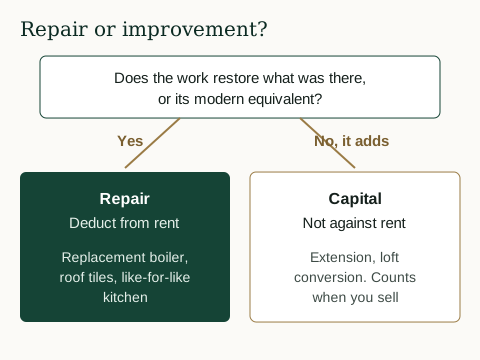
- Replacing single glazing with modern double glazing is usually treated as a repair, because it is the modern equivalent.
- Replacing a kitchen with one of similar standard is a repair. Knocking through to make it larger is an improvement.
- Building an extension or converting a loft is always capital.
Capital improvements are not wasted: they reduce the gain when you sell. Keep the invoices. See Capital Gains Tax on property.
Can I claim for furniture and appliances?
Not for the first purchase when you furnish a property. When you replace an item such as a sofa, bed, fridge or washing machine, replacement of domestic items relief lets you deduct the cost of a like-for-like replacement. HMRC Property Income Manual
Deduct anything you received for the old item, and any extra cost of upgrading beyond the modern equivalent.
Can I claim costs from before the first tenant moved in?
Costs incurred up to seven years before you started letting can be claimed as if incurred on the first day of letting. They must be costs that would have been allowable once the letting had started. HMRC Property Income Manual
Be careful with a run-down property bought cheaply. Bringing it up to a lettable standard usually counts as capital, because the low price already reflected the work needed. HMRC
What can landlords not claim?
- The purchase price of the property and the costs of buying it (these count for Capital Gains Tax instead)
- Capital repayments on a mortgage
- Mortgage interest as an expense (it gets a separate tax reduction: see how)
- Your own time or labour
- Costs that are partly personal, unless you can identify and claim only the business part
What mistakes do landlords make with expenses?
- Calling an improvement a repair. An upgrade or extension is capital, even if it was done at the same time as genuine repairs.
- Claiming the first set of furniture. Only replacements qualify.
- Claiming the whole mortgage payment. Capital is never allowable, and interest is relieved separately.
- Not keeping receipts. If HMRC opens an enquiry, a cost with no invoice behind it is hard to defend. Regular rental property bookkeeping avoids this.
The bottom line
Landlord allowable expenses come down to one test: was the cost incurred wholly and exclusively for the letting, and does it maintain the property rather than improve it? Revenue costs reduce your taxable rent now. Capital costs wait until you sell.
When a job mixes repair and improvement, split the invoice and keep the paperwork that shows how you did it.
Our landlord tax checklist lists the records to keep for each property.
Related questions
Can I claim the cost of my own repairs work?
You can claim materials, but not a value for your own time.
Should I use the £1,000 property allowance instead?
Only if your actual allowable expenses are less than £1,000. You cannot claim both. GOV.UK
How long do I need to keep receipts?
Hold on to them until five years have passed since the online filing date for that year's return. Receipts for 2026/27, for example, should be kept until at least 31 January 2033. HMRC
What if my expenses are more than my rent?
The difference is a rental loss. HMRC lets you use it to reduce the profit on your next year's lettings, but not your wages or pension. HMRC
Official sources
- Work out your rental income when you let property HMRC
- PIM3200: Furnished lettings (contents), including replacement of domestic items relief HMRC Property Income Manual
- PIM2505: Pre-commencement expenses HMRC Property Income Manual
- Tax-free allowances on property and trading income GOV.UK
- Property Income Manual HMRC
Figures were checked against these sources on . Tax rules change: check the source or ask us before acting.
Please note: this guide is general information on UK tax rules at the review date shown. It is not advice for your situation. Rules change and the right answer depends on your circumstances, so check the sources or speak to us before acting.